
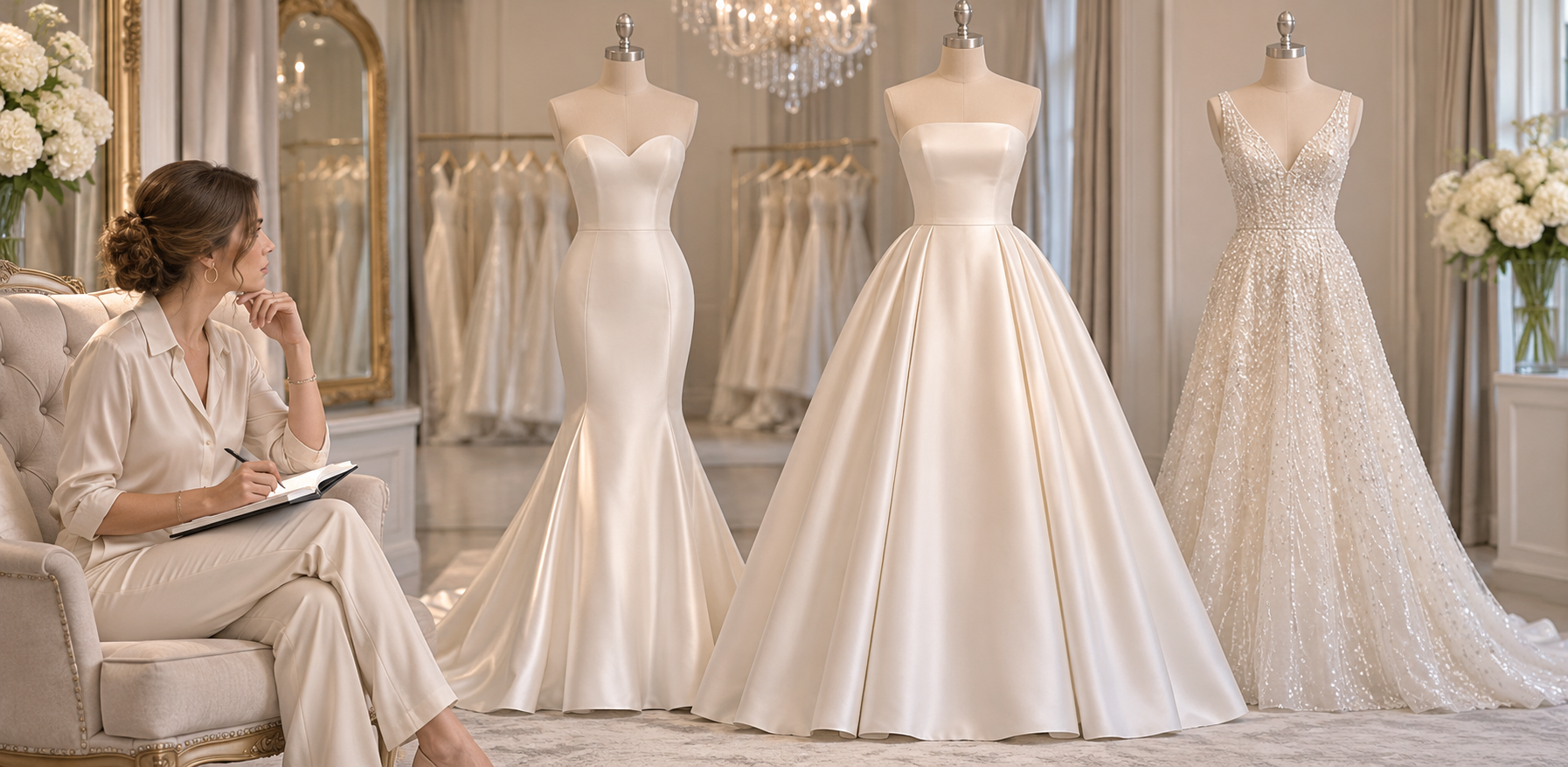
How to compare your favourite wedding dresses, work out what actually matters and make a decision that you'll be genuinely confident about.
You've tried on several wedding dresses. You may have loved two or three, but each one was different in some way.
You've got the one you envisaged. One feels absolutely lovely to move in. A third has lovely detail, but something feels off about it.
So how do you decide?
Comparing wedding dresses isn't about finding one that fits your budget. It's about understanding the differences between the gowns, knowing what you like, and ultimately figuring out which one actually suits you.
Having helped brides through this decision, I've learned that the most useful question is rarely 'which dress is the more beautiful?' It's usually 'what is it about how I feel in each dress that is different?'
What Should I Look for When Comparing Wedding Dresses?
A useful approach is to assess each dress on four criteria: Look, Feel, Move and Emotion.
1. Look: Shape, Proportions and Details
Look at each gown from the front, side, and back.
Consider the overall silhouette (where the waist falls, how the neckline frames the upper half of your body and how the fabric falls).
Ask yourself:
Do I like the shape and proportions?
Does the dress create the overall look that I'm after?
Which details actually appeal to me?
Is there anything I'd actually want to change?
Remember that the boutique samples may not fit at all. The pins and clips will show you the intended shape but won't guarantee how the finished dress will fit.
2. Feel: Comfort and Support
Notice how each gown feels against your body.
Does the bodice feel supportive? Is the fabric comfortable? Does anything feel heavy, restrictive or irritating?
Consider whether you'd actually want to wear it throughout your wedding day.
3. Move: Freedom and Practicality
Walk, sit, turn and raise your arms.
Notice whether you can move naturally or if you constantly have to adjust the dress.
Some restrictions can be improved with changes; others are inherent to the design.
Ask your consultant what can realistically be changed.
4. Emotion: Your Personal Response
Once you’ve considered the practical details, pause analysing for a moment.
Look at yourself.
Do you feel confident, beautiful, elegant, romantic or simply comfortable in your own skin?
Are you enjoying your reflection or trying to convince yourself you should love the dress?
Your emotional reaction may be the only thing that tells you anything that a list of features ever could.
How Do I Recognise Patterns in the Dresses I Love?
One dress can surprise you. Several dresses producing the same response deserve your attention.
Perhaps your faves have a defined waist, a clean neckline, or are made of soft, flowing fabric.
You might have imagined elaborate lace but repeatedly find yourself drawn to simple designs.
If you continually adjust a neckline or feel overwhelmed by heavy skirts, those reactions are useful information.
The purpose isn’t to restrict your choices. It’s to recognise what consistently works for you.
As these patterns become clearer, comparing dresses becomes easier because you no longer treat every beautiful gown as equally suitable.
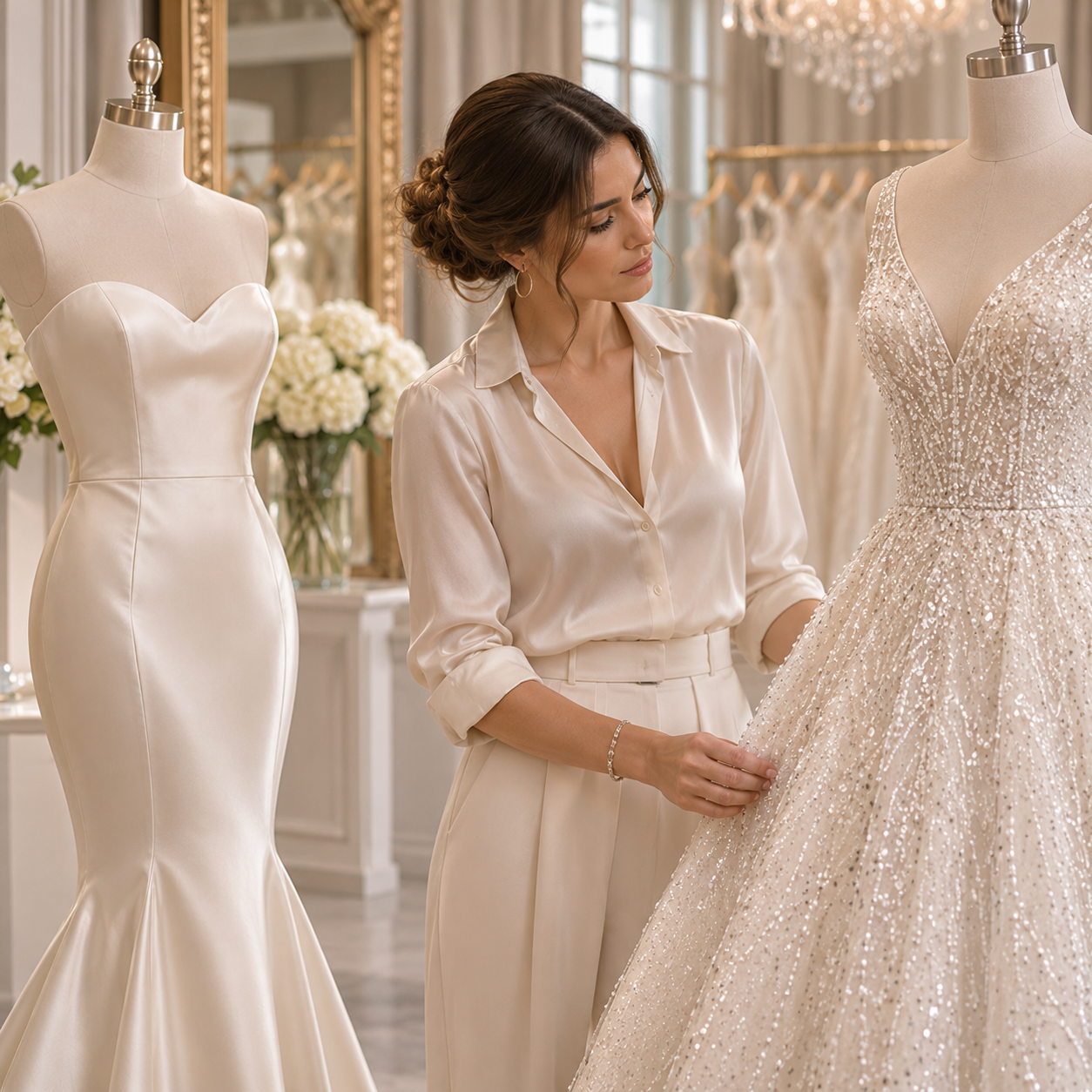
How Do I Choose Between Two Wedding Dresses I Love?
When two dresses seem equally appealing, identify what each one gives you that the other doesn’t.
One might have your favourite silhouette but feel less comfortable. Another may have simpler detailing but a more balanced overall appearance.
Ask yourself:
Which dress feels most natural when I’m wearing it?
Which features matter most to me?
What would I compromise on with each dress?
Which gown would I choose without anyone else’s opinion?
Distinguish between preferences and genuine non-negotiables.
You might prefer a dramatic train but choose a dress without one. However, secure bust support, freedom of movement, appropriate coverage or staying within your budget may be essential.
The right compromise is one you’re genuinely comfortable making.
If you’re still undecided, try your favourites again instead of adding more dresses to your shortlist.
Compare Your Favourite Wedding Dresses with Confidence
Keep your questions, notes and dress details together with the 23-page printable guidebook
View the guidebook on here →
Should I Trust Other People’s Opinions?
Family and friends can offer valuable observations, but their preferences may differ from yours.
One person might love the drama of a ball gown, while another prefers a fitted silhouette.
Before asking for opinions, observe your own reaction.During fittings, I found the happiest appointments weren’t the busiest. They were when the bride felt relaxed enough to respond naturally, not constantly watching others’ faces for reassurance.
Listen to advice, but don’t allow someone else’s enthusiasm to replace your judgement.
How Do You Know When You’ve Found the One?
One of the questions I was asked most often was, “How will I know when I’ve found my dress?”
No single experience is shared by every bride.
Some cry. Others smile, laugh or become completely quiet. Some know immediately, while others need to leave, think and return.
I remember brides who absentmindedly twirled because they loved how the skirt moved. Others would catch their reflection and suddenly carry themselves differently.
What stood out wasn’t always a dramatic emotional reaction. It was when they stopped analysing the gown and began enjoying themselves in it.
The dress no longer seemed like something they were trying on. It felt like a natural extension of who they were.
You don’t need tears or excitement to know you’ve found the right dress. Sometimes certainty is simply feeling at ease.
What If I’m Still Unsure About My Wedding Dress?
Uncertainty deserves attention but doesn’t automatically mean the dress is wrong.
First, identify whether you have a specific concern.
Perhaps the bodice doesn’t feel secure, the fabric is uncomfortable, the price exceeds your budget, or you’re unsure whether an alteration is possible.
But sometimes uncertainty comes from wondering whether another, even better dress might exist.
There will always be another designer, another collection and another beautiful gown.
A wedding dress may be worn for one day but the photographs can remain for decades. Understanding why you choose a particular gown matters more than simply reaching the moment you say yes.
What Should I Check Before Making My Final Decision?
Before ordering, confirm the practical details.
Check the designer, style number, colour, size, total price, expected delivery date and payment terms.
Ask if alterations and customisations are included, what changes are possible and if important agreements can be recorded in writing.
Read the cancellation and refund terms carefully.
Then return to your original feelings.
Do you love the dress as it is, not just imagining what it might become?
Are you comfortable with the commitment?
Are you choosing because you feel ready?
Your Wedding Dress, Your Decision
There may be several wedding dresses that look beautiful on you, but choosing isn’t about proving that one gown is better than every other.
It’s about understanding what matters to you, recognising your own response and making a decision that feels genuinely yours.
Take your time, compare thoughtfully, and let your preferences guide you.
The right wedding dress isn’t necessarily the one everyone admires most. It’s the one that allows you to feel beautiful, confident and entirely yourself.
PREPARE WITH CONFIDENCE
How to Compare Wedding Dresses With Confidence

Effective preparation isn't about knowing exactly which dress you'll buy; it's about knowing what to wear, what to bring, what to ask, and having the right information with you to make the most of your appointment.
To help you turn this expert advice into a practical companion you can take directly into the fitting room, consider picking up a copy of our interactive digital download, ' Your First Wedding Dress Appointment: What to Bring and What to Ask' guide from Good Looks Bridal, a 23-page downloadable and printable Guide.
This printable workbook is beautifully designed to keep your thoughts organised. It includes strategic preparation prompts, dressing room note pages, our signature Look, Feel, Move, and Emotion trackers, a consultant question ledger, and a comprehensive final checklist to bring total clarity to your first appointment.